Showing posts with label anthropology of symbols. Show all posts

Tuesday, 23 October 2018

13. Conclusion: Symbols and Society


Welcome to the final section of Symbols and Society. In this conclusion, I consider the limitations of what we have studied in this subject. I also introduce other directions to pursue in your journey into anthropology.

Summary of the course

By now you are probably developing your own sense of the history of the social sciences and anthropology. After all, in this subject, you have covered some of the major thinkers in social theory (Durkheim, Freud, Jung, Levi-Strauss, Geertz) and in anthropology (Frazer, Ortner, Wolf etc.). I would now like to suggest what do with your developing knowledge. How can you use these theories like a scholar?

To start with think of the theories as 'explaining tools'. The more tools you have, the more chance you can get the job of explaining done. By doing this course you have learned to use some of the most important explaining tools so far available anthropologists studying symbols. These explaining tools are so powerful that their use is not limited to just analyzing symbols. They are also used for analyzing religion and culture more broadly. Nevertheless, we have used the tools specifically to explain symbols in "Symbols and Society". Seeing as humans are unique in the way we use symbols; if we can understand symbols better, we might be able to understand some of the unique aspects of human life.

You need to be able to evaluate the pros and cons of each explaining tools. It's not necessarily easy to compare the theories. This is because the different theorists look at different kinds of symbols. Freud wouldn't have been too interested in Ortner's key symbol such as the body as a machine, for example. Nevertheless, you need at least to be able to evaluate the pros and cons for using any of the theories to analyze a particular symbol.

Because each theory of symbols has pros and cons, none is perfect. At the very least, I hope you've been able to identify the theories about symbols that you had before you started this subject, and that now you can compare the your old theories with the new theories you've learned.

Making this more challenging, new theories rarely emerge to provide a different answer to the same old question. Rather they purport to provide a new answer to a new question. One way to think of this is, effectively:

  1. Frazer asked, "where do symbols like the kissing under the mistletoe come from?". 
  2. Durkheim asked, "what function do symbols play in society?" 
  3. Freud asked, "why do we make slip up and mistakes in ways that indicate unconscious traumas?"
  4. Jung asked, "how come all these famous symbols have a similar form?"
  5. Levi-Straus pondered, "how come there is an underlying structure to myths, painting, social structures?"
  6. Wolf asked, "how do different groups/classes find the same symbol meaningful in different ways"
  7. Turner asked, "how do symbols connect up with other symbols; how do people explain the symbols in their lives; how are symbols actually used in ritual?"
  8. Geertz asked, "how do symbols make life meaningful for us?"
  9. Ortner asked, "what are the central symbols in a culture? how come some are worshipped, others not? How do the non-worshipped ones fit in?"
  10. Douglas asked, "if symbols make imperfect models of the world, what do we do with the things that don't fit in to our models?"

Possibly, I'm putting getting this the wrong way around, because, let's face it, all these theorists already had their answers to their own questions ready! Irrespective, they are posing different questions and providing different analyses.

That said, ways to interweave these theories present themselves. If we analyzed the Virgin of Guadalupe we could easily interweave Durkheim's sacred symbols, Wolf's multivocal, Geertz's deeply meaningful models of, and Ortner's key symbol of the summarising variety! Wolf also pointed to a Freudian Oedipal interpretation of the Virgin. Being able to combine theories indifferent ways is part of your developing scholarly/analytical thought.

The next step is to analyze what all the theories constitute together. Together they form part of the sub-discipline of Anthropology we call "Anthropology of Symbols". As a subdiscipline, the Anthropology of Symbols sits beside Kinship, Political Anthropology, Economic Anthropology etc. In other words, it is one of the classical subdisciplines of Anthropology. You also need to be able to analyze at this sub-discipline.

The decline of the Anthropology of Symbols

To repeat anthropology of symbols is a field of study within anthropology. Symbolic anthropology (which is a particular approach to anthropology particularly associated with Geertz and called 'culturalist' or 'interpretive') was merely one approach to the study of symbols in anthropology. But with the decline of Symbolic Anthropology, the Anthropology of Symbols went out of fashion too. After the 1970s, anthropology lost interest in symbols. You can probably gather, if you have followed this course from start to finish, that I think this is a great loss! So what happened?

Limitations of the anthropology of symbols

If nothing else, the critical thinking you've developed during the course of this subject, should cause you to call into question the entire validity of anthropological approaches to symbols. This presentation covers some of the more obvious reasons to be sceptical about the Anthropology of Symbols.

Turn to emotions

One critique of the Anthropology of Symbols relates to emotions. The critique, as first expounded by Rosaldo in "Grief and a Headhunter's Rage:, holds that focusing on meaning overlooks the significance of emotion. Of course, Geertz and Durkheim make reference to emotions in the context of rituals; they said that the emotions make the meanings seem more profound and real. But Rosaldo and then a whole new sub-discipline, the Anthropology of Emotions, came to take precedence over symbols.

Turn to the body

Another critique relates to the body. Anthropologists began to see the body as more significant in cultural life than symbols.  This was in part thanks to theories of embodiment (derived from the philosophers Merleau-Ponty and Heidegger). It was also partly due to the work of anthropologist Bourdieu who, drawing on Mauss's idea of Techniques of the Body, came to see habitus (the culturally- and class-specific ways in which our body operates in space) as crucial in understanding human life.

Ortner: Marxism rose and Culturalism fell

Ortner (2016) has another explanation. (Remember studied Ortner's Key Symbols approach in Section 10.) According to Ortner's history, in the 1960s, interpretive anthropology, which Ortner calls the 'culturalist' wing was associated with Geertz. This was pitted against a Marxist wing. The Marxist was associated with Wolf, who, after writing The Virgin of Guadalupe" became increasingly materialist in outlook. The Marxist wing evolved in the 1970s into new critiques of anthropology:
 in the 1960s and 1970s American anthropology was dominated by a split between a “culturalist” wing, led by Clifford Geertz (e.g., 1973) and his students, and a Marxist or materialist wing....  From the point of view of the culturalists, the work of the political economy scholars was reductionist: people’s motives were reduced to simplistic “interests,” and people’s lives were seen as reflexes of mechanical forces. From the point of view of the materialists, on the other hand, the work of the culturalists...ignored the harsh realities of power that drove so much of human history. The culturalist perspective prevailed through much of the 1960s and 1970s, at least in the United States. At the same time, and partly overlapping with the Marxist/political economy approach, new critiques were taking shape that also insisted on the importance of taking questions of power, inequality, domination, and exploitation into account. . The practitioners of these new kinds of work ... all agreed, at least implicitly, that anthropology had to start paying attention to issues of power and inequality, and in the long run, starting somewhere in the 1980s, they came to prevail.
Is this how it happened? What do you think?

Final words

Speaking personally, teaching this subject is a wild conceptual ride for me. The world appears radically different through each of the various perspectives we have studied. Considering the theories together, I feel amazed by the extraordinary power of our species to create symbols. Immersed in symbols make me not only human but also part of a specific society and culture. Yet the theories shatter the simple confidence I had that my understanding of the world, but reflects the world as it is. They suggest that what is meaningful to me emerges not out of the world but something else. It could be that meaning emerges the thought of our ancient ancestors, maybe our infantile trauma or universal archetypes, deep structures or cultural systems. Symbols, and thus the way I make sense of the world, are ordered according to principles that emerge from culture and society, and not from the world itself.

Thursday, 6 September 2018

Slametan: Javanese Ritual Meals (Special Topic 4)

In this special topic from the subject Symbols and Society, we'll work on the concept of multivocality in relation to a ritual meal known as the "slametan". But first, a word of warning; this topic requires managing a lot of detail.

Women preparing sweets for a slametan at my fieldsite in Banyuwangi, Java.

What is a slametan?
The word slametan refers to a kind of ritual meal frequently held in Java. As I have written:
Ritual meals are...an important aspect of orthodox [i.e. traditional Islamic] religion. Geertz called them “slametan”, and different words might also be used in different circumstances. The host invites neighbours, family, friends for a child’s birthday, to ensure the successful sale of land, or farewell a nephew visiting from the city. The guest’s wives help the host’s wife prepare a small plate of rice with some meat on the side at the host’s house. Usually, the husbands gather in the front room (ruang tamu) of the host’s house, after evening prayers, and lead by someone knowledgeable, recite passages from Koran. Then they gulp down the rice dish, share a joke, smoke a cigarette, then leave with a takeaway pack of the food. Leftovers are seized by any wives and kids who happen to be around (Herriman 2014)
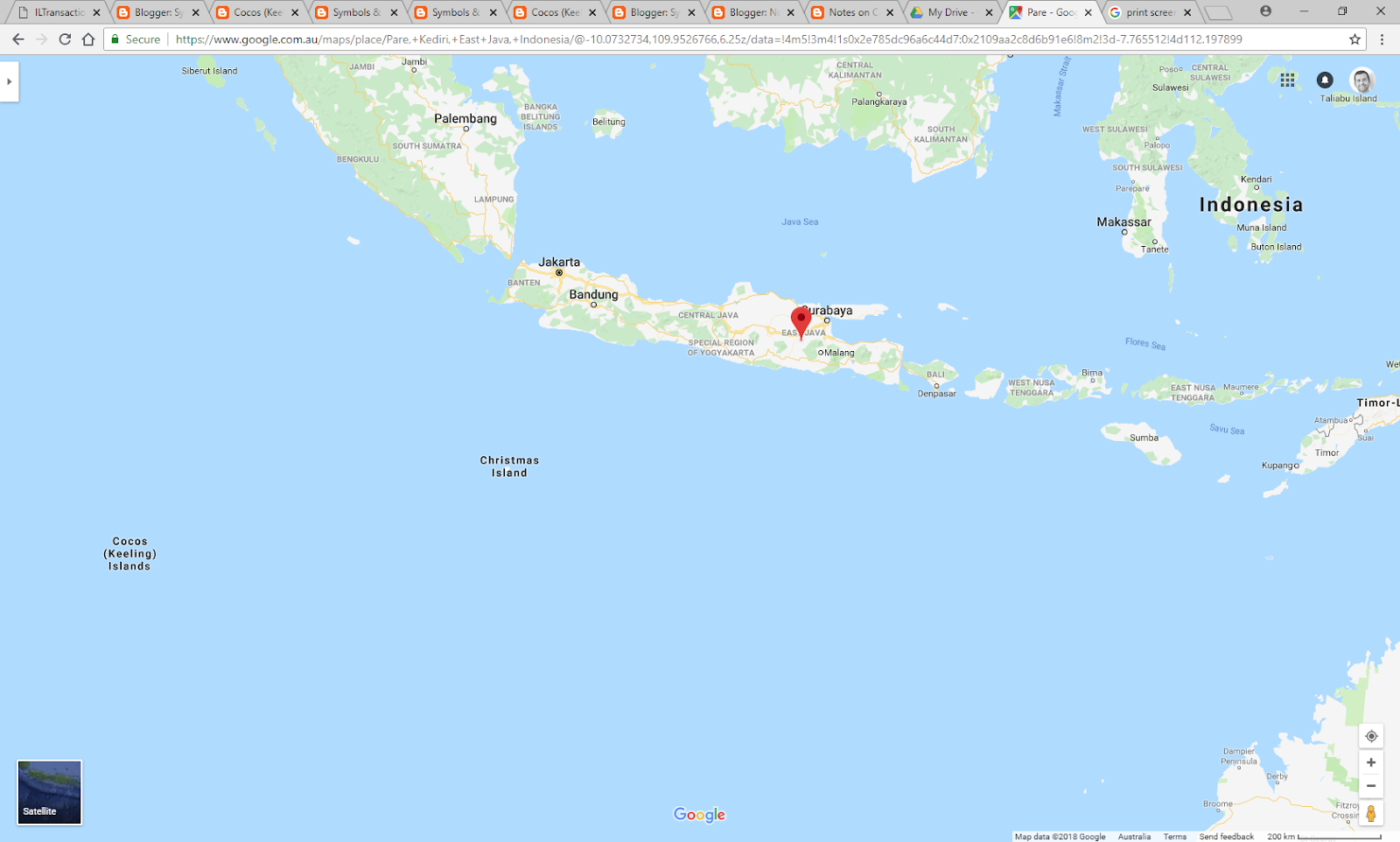
The red dot marks the location of Pare, Java, Geertz's fieldwork location, where, in the 1950s, he analysed slametan.

What does a slametan look like?

 For an overview, you could look at my 1 page explanation of ritual meals in Banyuwangi, Java, my first fieldwork location .

Slametan in Java (my first fieldwork location 2001-2002)
You can see the similarities between ritual meals in Java (my first fieldwork location) and  ritual meals among the Cocos Malays (my second fieldwork location). I have also blogged about specific ritual meals among the Cocos Malays, including a Feast for the Spirits of the Dead and  ritual meals at the end of Ramadan, the Fasting Month.

Men filling bags with takeaways at the end of a ritual meal on the Cocos (Keeling) Islands

The Cocos (Keeling) Islands, where I have done fieldwork 2012-, are indicated at the bottom left of this map.

Slametan as multivocal

Geertz
This apparently simple ritual meal has sparked a lot of academic controversy; at least in relation to Java. To start with, could read the first chapter of Geertz's classic Religion of Java. You might also like to look at my summary of this. What anthropologists of symbols take away from Geertz on slametan is that that 3 different groups come together at a slametan and the 3 groups get three different kinds of meaning out of the ritual. We anthropologists of symbols could thus say the symbols are multivocal, just like the Virgin of Guadalupe. To understand the three groups' perspective, we need to look at the larger topic of Islam in Java.


Islam in Java = Syncretic Islam

As in other parts of the world, the Islam in Java has unique features—it has been indigenized or domesticated such that it reflects both local as well as foreign influences. It is thus what anthropologists call "syncretic". Clifford Geertz’s (1960) seminal work on Islam in Java assessed these influences on the religion of the Javanese people, who primarily inhabit central and eastern Java. 

Islam in Java: 3 variants

On the basis of fieldwork in Pare, the author characterized Javanese religion as being composed of 3 ‘variants’, which correspond with the tripartite structure of Javanese society:

  1.  abangan, the peasantry, whose ‘socio-structural nucleus’ was the village. The abangan or folk religion is “a balanced integration of animistic, Hinduistic, and Islamic elements”;
  2. santri, small traders, whose ‘nucleus’ was the market (in the sense of “the whole network of domestic trade relationships on the island”). The santri religious tradition is “a purer Islam, less contaminated with either animism or mysticism” (1960:5). I will also refer to this religious culture as “orthodox Islam”; and,
  3.  priyayi, the gentry, formerly the aristocracy, whom the Dutch had transformed “into an appointive, salaried civil service” and whose “socio-structural nucleus” was the bureaucracy (1960:6). The priyayi religion is Hindu, incorporating “etiquette, art, and mystical practice” (1960:238).


Hence, Javanese religion was a syncretic Islam with the abangan ‘variant’ emphasizing animistic elements; the santri, Islamic; and the priyayi, Hindu elements within this syncretism. They call came together at the slametan ritual, which they all interpreted differently. Geertz insisted that these three variants were entirely separate in their mental outlook. 

Different interpretations of the slametan

What did the slametan mean to the 3 variants/groups in Java. 

  1. The slametan is central to abangan life. A commonly held ritual meal, the slametan expresses abangan belief in the importance of harmonious relations with other humans, spirits, ancestors and gods. 
  2. For santri, the emphasis in slametan is to worship Allah, the One, so these overtly pious Muslims they politely overlook reference to supernatural beings which are condemned by dogma.  
  3. Where the abangan might be animist, the santri monotheist, the priyayi engages in slametan from a mystical perspective. The priyayi sees deeper significance to the symbols of the slametan which connect the self with God and the universe. 
In these ways, the slametan could be seen as multivocal--providing different symbolic meaning to different groups

Wider application of Geertz's model?

 Geertz’s typology has been the most influential in the study of Javanese religion. It has even been applied more widely to describe various political historical phenomena through out Java (Hefner 1987b:534-5), even though Javanese are just one (admittedly the largest) ethno-linguistic group in Java. (Other ethno-linguistic groups of Java include Madurese, Sundanese, Osing). Even though some authors have felt the model as wider significance than even Geertz argued for, other scholars have questioned the model. Indeed, as a model for religion in Java, it has been subject to revisions, eight of which are discussed in the following paragraphs.

 8 revisions to Geertz

1. Religion and class do not always align.

Hefner (1985:3-4 nn.) records that “a number of scholars” have pointed out “that variation in religious orthodoxy cuts across class lines”.  One can find peasants or aristocrats whose Islamic beliefs and practices are as orthodox as santri.

 2. Using local ideas and terms does not provide accurate analysis

Closely related is the second revision, namely that Geertz employs the terms that his research participants to describe society. As such it could be called an ‘indigenous sociology’ or an ‘emic’ or as Geertz would prefer, an ‘experience-near’ account. However the use of the term “priyayi” to denote a religious culture by Javanese people has been questioned on the basis that it usually only denotes a class—the aristocracy.

3. Regional variation much more important 'socio-structural nucleus'

 Regional variation within Java is more important than socioeconomic class in explaining religious culture. For example, areas along the north coast (pasisir) have tended to be more orthodox, upland mountain areas have tended to cling to Hindu-Buddhist or animist beliefs (Hefner 1985; Koentjaraningrat 1985:318)

4. Geertz's fieldwork location was particularly divided


A fourth revision relates to the particularity of Geertz’s fieldwork location setting. The tense relationship between orthodox Islam and Javanist Islam that Geertz describes can be traced to historical factors such as a Communist Party revolt (Madiun) and intense party-politicking in rural areas which focused on, and heightened, differences in religious culture (known as aliran politics) (Hefner 1987b)

5. There are really only two variants.

A fifth revision has been to reject the tripartite structure. Koentjaraningrat (1985:316-7), for example, recognizes only two variants of Javanese Islam:

Variant A: “Islam of the religious people” (Agami Islam Santri) incorporates animistic and Hindu-Buddhist elements but “is much closer to the formal dogma learnings of Islam.”

Variant B: “Javanese religion” (Agami Jawi) is an “extensive complex of mystically inclined Hindu-Buddhistic beliefs and concepts, syncretistically integrated in an Islamic frame of reference” (Koentjaraningrat 1985:317).
 In this way, Koentjaraningrat (1985:316-7, 336) apparently subsumes the beliefs of Geertz’s priyayi and abangan religious variants into the single term “Javanese religion”.

6. Religious difference can be plotted along a continuum.

The sixth revision holds that the distinction between Javanist Islam and santri Islam is actually a continuum.  Geertz explicitly excluded this possibility of continuum, treating the different variants as discrete entities:
even amongst the most kolot [old-fashioned] of santri there has been a crucial shift when a man… becomes a santri. Nor can one simply say that the kolot-to-moderen scale measures the degree to which the principles have taken hold in the essentially abangan mentality of the Javanese (Geertz 1960:160).
Notwithstanding the idea that there is a continuum between santri Islam and Javanist Islam can be found in studies of Islam in Java, such as Woodward (1989:7) and Beatty (1999).

7. Sufism more important

A seventh revision pertains to the historical roots of Javanist Islam: namely, that it has been more influenced by mystical Islam or Sufism, than by pre-Islamic elements, such as Hindu-Buddhism (Woodward 1989:3, 242).  This could be attributed to the likelihood “that many of the merchants and travelers who introduced Islam to Southeast Asia were Sufis” (Barton 2002:64). Woodward (1989:6) argues that the distinction between Javanist Islam and santri Islam does not correlate with a distinction between “orthodox and syncretist Islam”, but rather a distinction between legalistic and mystical interpretations of Islam.

Perhaps the only safe conclusion one could make on the basis of these revisions is that there are two general trends in Islam in Java:

  1.  Javanist Islam emphasizes indigenous, Hindu-Buddhist, and/or Sufi elements, while
  2.  orthodox, normative, or santri Islam emphasizes ‘purifying’ Islam of these elements

8. The important distinction is between Civil and regimist Islam.


Finally, a new typology of Islam in Indonesia has been developed by Hefner (2000). Instead of defining his types in terms of differences of class or doctrine and practice, Hefner characterizes Indonesian Islam in terms of two emergent and rival traditions regarding the political role of Islam. “Civil Islam” is “pluralist” (2000:6) and affirms “democracy, voluntarism, and a balance of countervailing powers in a state and society” (2000:12-3). This is contrasted with a regimist Islam, which strives for an Islamic state without checks and balances (Hefner 2000:20).

 Accepting revision 5 for the sake of the argument leaves us with two major kinds of Islam in Java: Javanist Islam and santri Islam. This is the starting point for Beatty’s work Varieties of Javanese Religion.

The red dot indicates Banyuwangi, Java where Beatty did fieldwork in the 1990s, and I also did fieldwork 2001-2002.

Beatty’s mystical, practical Islam & pious Muslims

Beatty
This major contribution to the study of religion in Java is based fieldwork on research a village in mountain Banyuwangi given the pseudonym “Bayu”, as well as apparently shorter research periods in a traditional orthodox Islamic village and a Hindu community. Beatty is critical of accounts that explain religion from the perspective of ‘experts’ (urban Islamic preacher/scholars, sect leaders and so on) and instead searches to find the common- or middle- ground. For Beatty (1999:115-117) this religious common ground is what he calls “practical Islam”. Practical Islam is in the middle of a continuum with two ends:

  1.  Proponents of a purer version of Islam, whom Beatty labels “santri.” 
  2. Javanese mysticism is at the other side of the continuum. This  emphasizes worldly symbols of divinity (such as the human body, forests, foods) (Beatty 1999:158-186). 


Red and White porridge

Like Geertz, Beatty identified the multivocality of the slametan: people interpret the symbolic meaning of different rituals in their own way, and are not aggrieved by different interpretations (1999:49-50). Again from the two ends:

  1. For a pious Muslim, the red and white porridge of a ritual simply represent Adam and Eve.
  2.  For the mystic, Adam and Eve are “mere intermediaries”. 
The majority of people, i.e. those adopting, practical Islam,  have an opinion “falling somewhere in between…the two extremes (1999:38).

Aside from multivocality, another method by which local people deal with their religious differences is that the differences are brushed over such that questions of religion are not “spoken about, let alone debated” (1999:125-126).


My experience of Banyuwangi

A few years after Beatty, I also did fieldwork in Banyuwangi 2001-2002. I found evidence of the kind of religious diversity within Islam Beatty describes. It was apparent, of course, in Beatty's own fieldwork village and several surrounding villages. By contrast, elsewhere, in Banyuwangi, I was struck by the conformity of religious practice according to a pious, or santri Islam. Indeed, Beatty's fieldwork location was so unique that camera crews visited to film rituals there, it was set up as a tourist location, and the government has made a point of trying to preserve the special rituals. I decided to write a paper about that conformity of religious practice elsewhere in Banyuwangi. If you're interested, you can find it here.

Theoretical approaches to the symbolism of slametan

OK let's leave the debates over variants aside and rather focus on how the different theories might apply to the symbols in a slametan.
What would it look like if we applied Ortner's theory to something slametan and combined it with Geertz's theory?


Using Ortner, we could say that the slametan as an elaborating symbol of the ‘key scenario’ type. It's an elaborating symbol puts everything into context, helps you sort out ideas, explains how everything fits together, orders life. It's a key senario because it shows you how to live out life.

On top of this, we can also apply Geertz's ideas of models for and models. We could say that these elaborating symbols are models for how to behave. Maybe you act out gender roles, slamet is restored. It shows people how to act in the world: calm, resigned and peaceful. Also, as it is an unassuming and apparently insignificant ritual is not sacred like for example like prayers before fasting month.

Aside from the elaborating symbols, there are also models of. In the ritual how the world is and how to behave all hangs together For exathe colours of the porridge etc seem to be a model of Adam Eve etc.

As Geertz notes in rituals models of and for come together similarly the selametan is as much a model of society. We enact relationships with ancestors and with each other but is this in a symbolic way? Geertz says it symbolizes "the mystic and social unity of those participating in it" but is it a symbol or actually it? That is, it doesn't just make sense of the world, it actually creates order in the world. Anyway, it organizes their life: people are arranged equally, food is distributed, spirits are appeased and neutrality is achieved.


Final Words

There are no final words on the debate! Geertz started a fascinating conversation by analyzing a kind of ritual meal as having different meanings to different groups. The different groups could come together at the one ritual he observed. Ever since then different scholars have grappled with this idea. Maybe the debate has now run out of steam. But I hope not.

As for the different theories of symbols; I have applied Ortner and Geertz's own theory to the slametan. What other theories do you think illuminate aspects of the slametan?

Wednesday, 5 September 2018

Muslim Veils: Different Analyses (Special Topic 3)

Veils are piece of cloth that people wear around your head. Nuns of different cultures wear them. Jewish and Muslim women in different parts of the world wear veils too.


Issues surrounding whether Muslim women should or should not wear veils have been on-and-off the public agenda in many countries. In Western public discourse, you can find people supporting Muslim women veiling. Supporters might say "the veil is an expression of female agency" or "it’s just as an expression of religious piety". And you can find people opposed to it. Opponents might say, "it’s a rejection of all we stand for" or "it's simply an expression of male control over women". I find both views, for and against veiling,  uninformed by the kind of qualitative analysis anthropology gives.


Ostensibly, veiling is a religious issue. In the Q'ran, God says:
O Prophet! Tell thy wives and daughters, and the believing women, that they should cast their outer garments over their persons (when abroad): that is most convenient, that they should be known (as such) and not molested. And Allah is oft-forgiving, most merciful.
But this doesn't really help us anthropologists understand Muslim veils. Why?

In the study of religious adherence we tend to focus more on what ordinary, lay-folk believe. Some anthropologists focus on studying religious specialists (who in Islam might be called "clerics", "ustadz", "ulama", and other words). But although religious specialists are influential, as specialists, they are 'special', so we analyse their understandings as them as having very particular stances on matter.

In any case, what matters to us interpretation. As much as certain people would like to say there is only one correct interpretation of the Bible, Torah, Q'ran, Scriptures etc., they only say that because so many interpretations exist! As we can see from the research by Abu-Lughod and Lindquist the veil has a wealth of significance that can't be easily deduced from the Q'ran passage above.


I think the best way to  begin approaching this topic is an extension (literally) of the Hair Debate (Special Topic 2). The question of public vs. private symbolism remains crucial in understanding Muslim veils. From this one question anthropologists might ask is, "what do veils mean, personally, for women who wear them?"  The other question is, "what do veils mean in the cultures in which they are worn?"

In this, the third special topic, from my subject Symbols and Society, I consider two different accounts of veiling. From them, we get a sense of similarities and difference in the meaning attached to veils in two different Islamic cultures.


Image of Malay women wearing jilbabs (the Malay Muslim veil) at my field site, the Cocos (Keeling) Islands. These women are waiting to eat the food they have prepared for a communal meal.

 Abu-Lughod: Veiled Sentiments

Bedouin woman
GLOSSARY 
ghinnawa = poetry of yearning and love
hasham = modesty, shame, shyness, sense of being unworthy
tahasham = having hasham

It might be surprising given the title of the book, but in her Veiled Sentiments, Abu-Lughod only directly deals with the meaning of wearing a veil on p. 159. It must be remembered though, anthropology is mostly about providing context. Consistent with the idea of holism, anthropologists feel that one must have a picture of the whole culture and society (Awlad Ali Bedouins) before a single phenomenon (wearing a veil) can be understood. Also the word “veil” in the title is metaphorical; the ghinnawas, highly personal poetry, give veiled expression to highly personal and, in certain contexts, inappropriate poetry recited by women. So what does Abu-Lughod have to say about actual veiling in the physical? 

Bedouin Wedding Procession

The immediate context is tahashsham. I’m going for a simplified explanation that will leave the experts rolling their eyes: hasham is a feeling a shame, shyness, and unworthiness. Tahashsham refers to women who comport themselves in an appropriate manner. A woman who tahashsham is disinterested in sex; avoids contact with most men (aside from those of her father's family); is publicly disinterested in her husband. And most of all, for our purposes, women who tahasshsham wear a thick veil. They particularly do this in the presence of male superiors and strangers. To understand this in detail you'll need to read pp. 153-159 of Veiled Sentiments, which is available online at most university libraries. I have also tried to summarise it here:

Lindquist: Maju, malu and veils

Glossary:
Maju= advanced
malu = coy, shy, reserved
jilbab = veil which leaves face exposed

Located near Singapore and Malaysia, the Indonesian island of Batam is replete with modern factories and brothels. Singaporean men use it as a source of cheap labour and cheap sex. For an analogy, you might consider Tijuana; the Mexican city just over the border form San Diego, where young American men might go for buck's nights etc.


Factories in Batam as a rule typically only employ young women (it used to be the virginity was also tested!).  Lindquist writes about Indonesian women have migrated from all over Indonesia to Batam to work in the factories:


“As unexpected as it might seem, migrant women sometimes wear Muslim veils or take ecstasy in the same places and for the same reasons,” writes Lindquist. The factories, as a rule, employs only young single, high-school educated females. These young women may feel ashamed because they have travelled to demonstrate their personal development; but often fail to save money and ‘get ahead’ and be maju. To be maju is to be up-to-date, developed, cutting edge. A country that has made itself maju is Korea or Japan; a Muslim that has made herself maju would be sophisticated and embody the latest in practice and thinking about Islam [which would include wearing the veil]. The opposite of maju is to be backward, rural, traditional. Migration is about becoming maju and not malu (modest, shy, embarrassed).
Batamindo Industrial Complex

“In conversations with workers who wore the veil it was clear that most of them began to do so only after they had arrived on Batam. The typical response to my enquiry about this was that they had only just ‘become aware’ (baru sadar). For instance, Widya, from the city of Yogyakarta in Central Java, claimed that she had always wanted to wear a jilbab before she came to Batam, but that it was rare there. While in Java it was easy to be branded fanatik (cf. Brenner 1998:232), on Batam one gained support not only from roommates but also from the agencies and companies that recruited them. Widya continued: ‘one of the good things about working here is that there are a lot of religious activities. In the kampung [my village of origin] it is usually only on Hari Raya [the day of celebration that breaks the Islamic fasting month] that there is anything going on.’


One aspect of personal development these young migrant women can work on is religion—there are more religious activities and information sessions than where they came from. Wearing the veil (jilbab) is part of this religious development; they need not return to their home feeling malu, even if they have little money saved, at least the veil shows they are developed. Lindquist writes:
In the [Batam industrial] estate, however, it is possible to take part in religious activities on a daily basis, either in the main mosque or in a wide variety of organizations that are organized through particular companies or by community-based groups created by workers and supported by the estate management. The interests of the workers, the companies, and the local government appear to converge, as the movement of workers is restricted to the mosque (or the church), the dormitories, and the factory. The development of the [Batam] industrial estate is matched by the spiritual development of the worker” (Lindquist 2004, 493).

At a more complex level, Lindquist ties wearing a jilbab in with morality, affect, subjectivity, nationalism, migration and various other concepts. According to Winarnita (2011) for Lindquist, modesty/shame/shyness or malu is:
a key emotional trope [for female migrants to Batam]…Lindquist argues that in migration malu should be understood in relation to representations connected to the originating nation…to him malu is an important starting point for thinking about the motivations and actions of Indonesian migrants in negotiating their hopes and frustrations. [Lindquist] he sees the women migrants as having agency in which malu becomes a reflexive management of appearances in the face of dramatic economic and social change.
You want to show how advanced you are by succeeding in migration both in earning a wage and becoming a better Muslim. Thus wearing a veil symbolises to others that one has become advanced or maju.


Symbolic Significance

The veil could thus be seen as symbolising something personal for the wearer herself (such as her personal journey to Batam). She also sends out message to others about herself, whether it be that she is malu or tahasham. To understand these different levels of symbolism it is useful to refer to the great anthropological debate regarding hair.

Summary

So for Lindquist failing in migration makes female workers feel malu. To deal with this feeling of malu, the sex workers take ecstasy. Those who work in factories want to feel like they have 'made it' and one way of showing of success is religious development. And one sign of religious development is wearing a veil. When the workers go back home, they wear a veil, they can feel less malu. Feelings of malu lie behind both taking ecstasy (for sex workers) and wearing a veil (for factory workers).
For Abu Lughod, writing about Bedouins, wearing a veil is also related to feelings of hasham

Reflection

I think of hasham and malu as important symbols and feelings. The feelings/states they relate to include modesty, humility, shame, shyness, coyness, chastity etc.

Sunday, 26 November 2017

11. Symbols & Categories--Douglas


Welcome to Section 11 of Symbols & Society. 


Confession time.

When I was about 14 years old, I was hanging out at my uncle and auntie's house. A bloke grabbed a big cockroach and chased me with it. I shrieked! 

I had a pet mouse which I used to hold when I was a boy. But when I was older and living in my student hovel, a mouse ran across the floor near my feet. I jumped up and almost hopped up on a sofa. 

The same insect in one culture makes people scream in disgust; in another culture it's dinner. A mouse that is caged was fine for me; a mouse that is free to run inside and out made me jump.
 
Pork is a delicacy in many cultures, but in others it is filthy. Why?

Mary Douglas's "Abominations of Leviticus" argues that filth is culturally specific. Different cultures create unique symbolic orders. These symbolic orders divide up the world into different categories. No symbolic order is perfect; certain objects or things transgress or defy these orders. Such objects are liable to be thought of as disgusting and filthy. 


Inside your hotel bathroom you find a little green plant sprouting from the mold.
Do you find this clean or filthy?


Frogs

Let's take the example of frogsEnglish speakers divide the world into:
  1.  marine animals and
  2. land animals. 
You can eat marine animals (fish) and you can eat land animals (chickens). But animals like frogs spend their entire life going from the water to land and back again. As a result they don't fit into our categories of land and marine animals. We view them with disgust. 

But frogs are also associated with supernatural power. For instance, we imagine witches would put frog legs in their cauldron 

Cows and other ruminants

Before we get going with he next example, you might want to know a little about ruminants and their rumination.

Ruminants = animals with 4 stomach compartments (cows etc.)

Ruminants include cows, goats, sheep, giraffes, & camels. I think of them as animals which chew on grass, vomit it up and eat it again.  This process is called "rumination" or "chewing the cud".  What distinguishes ruminants is their 4 stomach compartments. 
 he first of these 4 compartments is called the "rumen". This word can help you remember "ruminant"

Rumination

 And now behold! The magnificence and excitement that is rumination:

I know you could probably watch that all day, but, once you have regained your composure, it's time to move on to another fascinating aspect of biology. My feet have a heel, arch, and toes. My cat has paws. A cow, by contrast, has a hoof (foot) which looks like it's made of two bits:

You can call this a "cloven hoof". Confident of this you are ready to move on and read Douglas.

Abominations of Leviticus

"The Abominations of Leviticus" is a famous chapter from Douglas's book; Purity and Danger.

After reading the chapter, please take a look at my presentation:


Please feel free to use my notes on this presentation.

Supernatural power and abomination

One connection is crucial to point out here. We associate filth with supernatural power. 


Critical thinking

How can we situate Douglas's theory? Anthropologists sometimes call Douglas's approach in "The Abominations of Leviticus" 'soft' structuralism. Why 'soft'.

In one sense she's a structuralist. She argues that filth only makes sense in relation to an entire system of symbols.

But she differs from Levi-Strauss's 'hard' structuralism in that she doesn't make hard-and-fast binaries and strict rules that apply to all cultures. She also describes meanings with more nuance and attention to how local people understand symbols; this makes her closer to the interpretive style of symbolic anthropology.


Summary 


According to Douglas, our systems of ordering or classifying the world seem natural to us. In other cultures, different systems of ordering or classifying the world seem natural to them. This indicates that that the systems of ordering imposed upon the world. And they are imposed differently in different cultures. This has a morose implication; we can never access reality directly, only via culturally specific ways of ordering the world. Evidence of this emerges in the gaps. In all these different cultural systems, there are gaps or left-overs in-between categories. From these gaps, disgusting (and powerful) things emerge! The Section 11 take-home message? What doesn't fit into a culture's symbolic system counts as filth.

Further study: The Abject and Filth

Kristeva's idea of the abject (something lying outside the symbolic order) can be usefully combined to Douglas's idea of filth.

10. Key Symbols--Ortner

Welcome to Section 10. In Section 9 we considered Geertz's idea of culture as a set of symbols. This week, we consider yet another Symbolic Anthropologist who takes an Interpretive Approach; Sherry Ortner.

Identifying Key Symbols

Can one or several symbols can tell you all you need to know about a culture? Sherry Ortner thinks so. According to Ortner, a few key symbols are crucial to understanding any culture. To establish whether a symbol is key, you can:
  1.  analyse a cultural system and chose which symbols formulate the underlying elements of the culture (i.e. what you as an anthropologist think is important)
  2. look at what people say is important (i.e. what they say is important)

There is “not one key symbol to every culture; cultures are of course a product of the interplay of many basic orientations, some quite conflicting”. 

Key symbols are not 'hidden'; they are 'out there'

Ortner writes that all key symbols will “be expressed somewhere in the public system, because the public symbol system is ultimately the only source from which the natives themselves discover, rediscover, and transform their own culture” (94). This point probably relates to the public vs private debate regarding hair symbolism. I think Ortner's saying that she's not too concerned about what the necklace you inherited from your great aunt means to you. She's concerned with the symbols we [the 'natives' of our culture] share with others in our group or society; like the national flag, the cross etc.

Summarizing and Elaborating Symbols

Ortner distinguishes summarizing from elaborating symbols? What is the difference between the two?

1. Summarizing symbols ('feeling with' symbols)

Summarising symbols are, for example, the cross, and the flag. They sum up, represent in an emotionally powerful. Summarising symbols are those in which we have an emotional investment; Virgin Mary. To identify one I think of summarizing symbols as basically Durkheim's sacred symbols. They are sacred so you don't want to see them desecrated. Because we feel very strongly about these symbols, I think of them as 'feeling with' symbols.

 2. Elaborating symbols ('thinking with' symbols)

Elaborating symbols are rarely sacred Elaborating symbols are good to think with e.g. man as a machine; cricket and baseball provide metaphors for life. There are 2 kinds:
a.       Root metaphors "provide categories for conceptualizing the order of the world”
b.      Key scenarios "have elaborating power : provide categories
Both provide orientations i.e. cognitive and affective categories; and “strategies” i.e. programs for orderly social action in relation to culturally defined goals” (95). We use these symbols more for thinking with than for feeling with, so I think of them as 'feeling with' symbols.

 2a. Elaborating symbols: Root metaphors

 One kind of elaborating symbol is root metaphors. They provide categories for conceptualising experience. COWS provide many categories for the Dinka. The LIVING ORGANISM, Douglas notes, often provides a category for conceptualising social phenomena; now machines sometimes provide this metaphor (e.g. CARS: That guy's a always firing on all cilinders, living life in the fast lane"). Root metaphors also illuminate the life, space, and time as the WHEEL in Indo-Tibetan culture. Therefore they “sort out experience, to place it in cultural categories, and to help us think about how it all hangs together”.

In my society, we use COMPUTERS as a model for brain: I can't process what's going when it's noisy; there are too many inputs.

Maybe you could also say we HAIR is a root metaphor: "That was a close shave. Nex time you let you hair down be more careful. Don't get in the way of uptight [?] people. The bullet came within a hair's breadth of your shoulder.

2b. Elaborating symbols: Key scenario

The other kind of elaborating symbol is provides modes of action. Ortner implies that there are several categories of key scenarios. Every culture, Ortner writes, has its own "vision of success" and what it considers "the best ways of achieving it". These 'best ways to achieve to it' are key scenarios. Her writing on key scenario is tentative and vaguer than her usual clear style, but Ortner seems to outline three kinds of key scenario:

  • Myths. These include the rags-to-riches story that is part of the American dream. This provides young Americans with a model to live-by. Young Australians are happy to leave uni and get a 'proper' government job. Young Americans are happier going out alone, using their individual and entrepreneurial skills to make it big. 
  • Rituals. Success and the way to achieve it are "dramatized for all to see" in certain rituals. These rituals would include naven, slametan, and potlatch. Key scenarios may also include formal, named events which are enacted according to unarticulated formulae. In Ortner's words:"they formulate the culture's basic means-ends relationships in actable forms". They are "modes of action appropriate to correct and successful living in the culture". 
  • Key cultural strategies. For Minangkabau of Indonesia the model for a successful life is to leave home, make a fortune, return every year for overflowing with gifts for everyone at the end of fasting month, bring honour to oneself and one's family. 

So, working through this with my student Jacq, we think that in Australia, possibly the Australian Dream of getting married and owning a house is a key scenario of the key cultural strategy type. Australians tend to freak out about not owning a house (an apartment/condo will not do; that will apparently ruin Australian families!).

Another contemporary Australian example from Jacq relates to an in ideal female key scenario. The idea is that you get out of the home, have a career, prove you are successful outside the home, then you marry and have children, you give up your prestige and career for your children and husband, in fact your prestige transfers to your husband. And that is a model for women to live out. It is expressed as a narrative in a movie called "Kate and Leopold"; the message is you sacrifice your career for your children.

As far as rituals, we could say that the potlatch, a feast with elaborate gift-giving and communion with spirits, shows Kwakiutl people what success is and how to achieve it. To take an example of rituals in contemporary Australia, as my colleagues in Anthropology at La Trobe University point out, "schoolies" a week in which graduating high school students congregate at famous holiday areas, is a correct and successful way of being a teenager. (It also happens to be the liminal phase of the rite-of-passage from high school student to graduate). In America, "Spring Break" is part of being successful college student; and for parents or grandparents hosting a Thanksgiving is part of success. 


Summarising vs elaborating symbols

Elaborating symbols are for catalysing thought and action. Summarising symbols are more about emotional commitment. But it's probably useful to think of elaborating and summarising as two ends on a spectrum of symbols. As Ortner stipulates, the distinction between elaborating and summarising is one of function, and either kind could always function differently (e.g. a cross could inspire someone to martyrdom).

Reading Ortner

OK now I've confused you with my interpretation, it's much better to read the original: Ortner, SB 1973, 'On Key Symbols', American Anthropologist, vol. 75, no. 5, pp. 1338-1346. (jstor.org/stable/674036).


You might also, if I haven't put you off, want to watch my presentation on Ortner's ideas:


Here are the notes for my Ortner presentation.

Expanding Ortner's 'Root Metaphor' Concept

In developing theoretical competency, or critical thinking, it is important that you push your understanding past just remembering and recognising theories. You also need to apply and combine theories.

Here's an example. In Metaphors we live by, Lakoff and Johnson (1980) provide possibly more than 100 examples of everyday metaphors used in Western, English-speaking cultures.

To repeat, in this subject, I'm not looking at 'creative' and 'artistic' use of symbols by poets, novelists, artists etc., nor are Lakoff and Johnson. What they call "everyday metaphors" seems exactly like Ortner's "Root Metaphors". These  include: 
  1. ELECTROMAGNETIC FORCE as a symbol for love: When I first met him I felt attracted to him, but we needed a spark. There is an incredible energy between us, it’s like the atmosphere is charged.
  2. MONEY as time. "Can you spare me five minutes of your time? I've invested so much in our relationship and it's come at a huge emotional cost. I don't know if it's worth me going on." 
We don't use HUNGER metaphors in either case. In the USA, we don't say:
  1.  "When I first saw him I felt thirsty for him, but we need an appertif. There is an incredible gas cooker between us, it’s like the soup is lemony
  2. “Can you cook for five minutes of your time? I haven’t eaten much in our relationship and it’s come at a huge emotional hunger. I don’t know if it’s the flavor for me to continue. 
But perhaps we use HUNGER metaphors in other scenarios, such as sex: she's got hungry eyes but I don't have the appetite

Let's now take Lakoff and Johnson and compare their ideas with Ortner. From Ortner's persepective, we could say that:
  • ELECTROMAGNETIC FORCE is an elaborating symbol for love, and, 
  • MONEY is an elaborating symbol for time.
Alternatively, using Turner we could say  that
  • ELECTROMAGNETIC FORCE is a positional symbol for love, and, 
  • MONEY is a positional symbol for time.
    In summary, it seems to me that: 
    •  Lakoff and Johnson in "Metaphors We Live By"'
    •  Ortner on Elaborating Symbols, and
    •  Turner on Positioning Symbols 
    are talking about the same thing. They are talking about symbols/metaphors that connect with other symbols and signs.

    Key Symbols in the Kwakwaka'wakw Cannibal Dance

    In his Cultural Anthropology, Robbins applies Ortner's (and Geertz's) ideas to the Cannibal Dance of the Kwakwaka'wakw. I've used his ideas in this blog.

    Critical reflections

    Note that Ortner’s elaborating symbol seems to develop Turner’s positional symbol idea. Also it seems that Ortner's summarizing symbol is based on Durkheim's sacred symbols. Thus, the beauty of Orther's theory is that it ostensibly brings two formerly disparate theories (of Durhkeim and Turner) together.

    Ortner's theory about elaborating symbols also works well with Lakoff and Johnson. Lakoff and Johnson are not anthropologists, they hail from the field of hermeneutics. Unfortunately, as scholars we have a hard enough time keeping with developments in our own disciplines (actually it's difficult enough to keep up with sub-disciplines). I wish Lakoff and Johnson had got together with Ortner; their results might have been magnified.

    After reading Lakoff and Johnson, I think that root metaphors probably number in their hundreds in my own culture. So I'd say that Ortner made a more important discovery than she gives herself credit for. She showed a way to link what we might call the idioms of a language to a culture and society. By contrast, I have struggled to apply the idea of key scenario in many instances, possibly because I'm still a little unsure about what this concept means.

    Conclusion

    In Section 11, we will consider Douglas's idea that systems of symbols are imperfect reflections of reality and out of these imperfections filth and disgust emerge. For now, the take home message: In a symbolic system, some symbols work to organise the system (elaborating); others work to sum up powerful feelings and crucial ideas (summarizing).